

 +44(0)1522 693522
 info@doortechnik.co.uk
Access Control Locks
Access control locks are electrically operated door locks - maglocks, shearlocks, electric strikes and motorised locks - that keep a door secured until it is released by a keypad, card or fob reader, an intercom, or the fire alarm. The right lock depends on whether the door must fail unlocked (escape doors) or fail locked (fire and security doors), and on the door itself: a steel doorset takes a strike or motor lock in the frame and leaf, while a frameless glass door uses patch locks and rails.
Access controlled doors are commonly used to limit, control, or monitor access to a building, zones within, or individual rooms. Whilst keys or push-button handles can be a simple method of access control, access control is normally taken to be an electrically operated system which keeps doors locked, until released by a signal from:- Telephone or video entry system overseen by a receptionist or security guard - (press button to release)
- Numerical keypad, proximity reader, swipe card, or biometric reader (finger, face, voice etc)
- Fire alarm
To be part of a building’s access control system, doors need to be fitted with an electrically operated locking mechanism. DoorTechnik doors may be fitted with maglocks, shearlocks, electric strikes, or motorised locks, which will connect to most commercial access control systems running at 12V or 24V.
Lock choice is determined by the powered or unpowered lock behaviour, and by the door type.
In general:
- Maglocks and shearlocks unlock when power is withdrawn (fail unlocked)
- Electric strikes and motorised locks are normally selectable to be either locked or unlocked when power is withdrawn
- Escape doors must be unlocked when power is withdrawn
- Fire doors and security doors are locked when power is withdrawn
Locks should be specified, configured and controlled to suit the door types as follows:
|
Door Type |
Unpowered lock state |
Suitable access controlled locks |
|
All escape doors, whether fire doors or security doors or not |
Unlocked |
Maglock, shear lock. Electric strike or motorised lock, when set to fail unlocked. |
|
Non-escape doors fire doors Non-escape security doors |
Locked |
Electric strike or motorised lock, when set to fail locked. |
Note that escape door functionality take precedence over that of fire doors and security doors, so that escape doors of any type must unlock when unpowered.
For the UK, further guidance concerning escape doors and their locking systems, and fire doors, may be found in the following publications:
The Building Regulations 2010, Approved Document B
The Building Regulations 2010, Approved Document B1, 5.10 Doors on escape routes, 5.11 5.12 Door fastenings
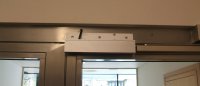
Maglock
|
Shearlock |
Electric Strike |
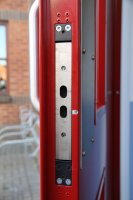
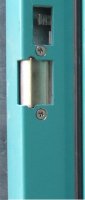
Maglocks
A maglock (electromagnetic lock) is an electromagnet fixed to the frame head with an armature plate on the door leaf; while power is on, the door is held shut. Maglocks and the concealed shearlock version release as soon as power is cut, so they are fail unlocked and are the usual choice for escape doors, released by the fire alarm and by a push-to-exit or break-glass unit on the escape side. Surface-mounted maglocks are simple to fit to new and existing steel doorsets; shearlocks sit inside the frame head and are hidden when the door is closed.
Electric strikes
An electric strike replaces the standard keep in the door frame and releases the latch of the mortice lock when it receives a signal from the access control system. Strikes can be supplied fail locked or fail unlocked, so they suit non-escape fire doors and security doors (fail locked), and escape doors when set to fail unlocked. The door keeps its mechanical lock and lever handle, so it opens normally from the inside and can still be opened by key if the system is down.
Motor locks
A motorised lock (motor lock) is a mortice lock whose bolts are driven in and out by a motor on a signal from the access control system. It gives the security of a multi-point mortice lock with electric release, can be set to fail locked or fail unlocked, and is the usual choice on higher security steel doors that also need convenient controlled entry. Electric handles work in a similar way: the outside lever is locked or freed electrically while the inside lever always opens the door.
Access control locks for glass doors
Frameless glass doors such as our GL15 have no mortice, so locks are fitted in patches or rails: a central patch lock with lever handles or a deadlock, and top and bottom locks built into the patches or rails. For access control the rails carry a concealed transom shearlock or a bottom solenoid lock, which connect to the same 12V or 24V systems as a steel door. Our steel-framed SG20 glass doors take the same electric strikes and motor locks as our steel doors.
Fitting and wiring
DoorTechnik doorsets can be supplied with the lock, an electric hinge or door loop for the cable, and concealed wiring already fitted, and are tested in our factory before delivery. Locks are available in 12V or 24V, AC or DC, and doorsets can include door position sensors and reader mounting points. Send us the access control system specification and we will match the lock behaviour, voltage and monitoring to it.